


The Pothole Tax: Why TN is Banning 'Loophole Weed' to Build a Billion-Dollar Road Fund


We like to pretend Tennessee has always been a “straight-edge”
state, but that’s a myth. Back in the 1800s, the state was a hemp powerhouse—even considering marijuana the “patriotic” cash crop. Hemp was the crop that built our early economy and practically paid for our original roads. We only “canceled” it when big-city politics and “Reefer Madness” propaganda took over.
When Governor Austin Peay built our modern road system in the 1920s, he came up with a revolutionary resolution. He added a “gas tax” because he realized property taxes couldn’t keep up with the automotive age. His logic: If you use roads, you pay for the roads. But with more electric cars on the road and fuel-efficient vehicles, they’re not collecting enough taxes to build for our growing population.
With I-75 “pothole capitals” like Knoxville consistently ranking in the top three for damage claims, the crisis is hitting home. TDOT has a massive $125 million pavement investment for the 2026 fiscal year, but they are playing catch-up. Crews are out this week in Rutherford County on SR 2, with flaggers doing heavy pothole patching between Log Miles 7 and 14. I-75 on the “Jellico Gap,” near the Kentucky line, is still one of the most complained-about stretches, with rolling roadblocks scheduled just to keep up with emergency repairs.
TDOT crews have already put in over 99,000 staff hours this year fighting the "Pothole War," yet I-75 in Anderson County still managed to take out 20 tires in a single day. (TDOT is begging people to call 833-TDOTFIX because the holes are opening up faster than they can scout them.)
We’re also in a structural decline. Tennessee has 20,374 bridges (10th most in the U.S.). Of those bridges, 36% were built before 1970 and are past their design life. Over 6.3 million trips are taken across “poor” bridges daily. Most people don't realize that 1 in 25 bridges they cross in Tennessee is officially rated as "Poor."
How Tennessee Bridges Rank as of 2026:

The state just dumped $20 million into "Spot Safety" projects for 2026. These aren't even for new roads; they are just fixing "high-risk" areas where the current road design is causing too many accidents—like Morgan County’s Knoxville Highway. In 2025, we saw families devastated by head-on collisions on Highway 62. Morgan County now ranks 14th in the state for fatal crashes.
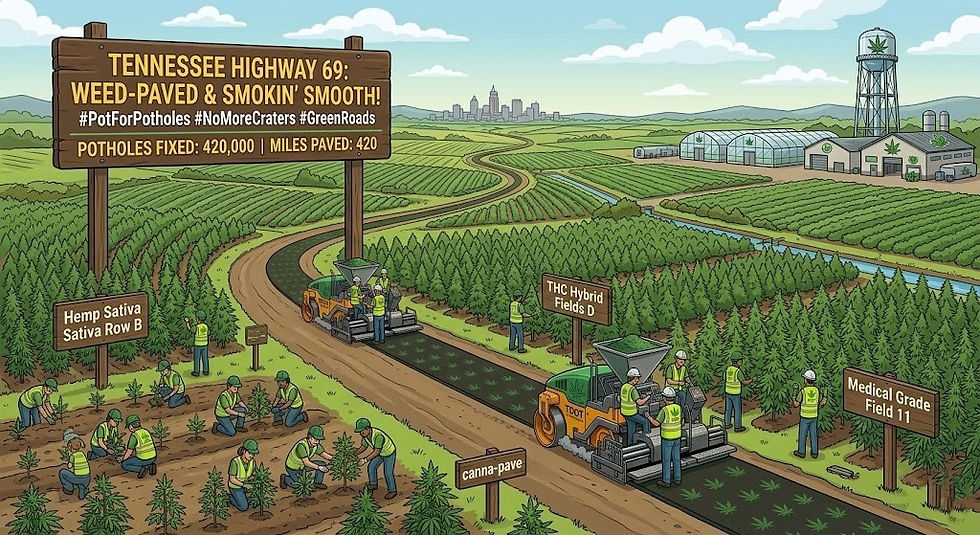
Introduced by state leaders like Senator Heidi Campbell and Representative Aftyn Behn, the "Pot for Potholes Act" (SB 2440 / HB 2525, officially the Tennessee Cannabis Act) proposes a regulated recreational market for adults 21 and older.
Even if the current bill stalls, SB 0960 is pushing to put three non-binding questions on the November 2026 ballot. The ballot would ask for a simple YES or NO on the following:
"Should the State of Tennessee legalize medical marijuana?"
"Should the State of Tennessee decriminalize possession of less than one ounce (1 oz.) of marijuana?"
"Should the State of Tennessee legalize and regulate commercial sales of recreational use marijuana?"
This is an "Advisory Referendum." Even if 100% of people vote "YES," it doesn't automatically change the law. It’s essentially a state-wide poll meant to force the legislature to see that their own voters want change.
The “Pot for Potholes Act” (SB 2440) proposes a 15% tax on recreational marijuana statewide that would go directly to the State Highway Fund. An extra 5% local tax would go into a “Cannabis Community Reinvestment Fund” specifically for areas heavily impacted by past drug enforcement.
Why the whiplash? Tennessee just underwent a massive change that many people confuse with legalization. As of January 1, 2026, regulation moved from the Department of Agriculture to the Alcohol Beverage Commission (ABC). Any product that results in more than 0.3% Total THC after being heated (decarboxylation) is now illegal. This effectively wiped out the "legal loophole" weed (THCa) being sold in shops across the state. Tennessee was cleaning up untaxed items to directly start the system they want.
This still does not directly solve the interstate issue, as the federal government funds 90% of those projects. Inflation is the main issue with the $82.7 billion in infrastructure needs identified for the next five years—this is the total cost for all projects state and local officials say we need, not what we’re in debt for. Tennessee has never gone in debt for a road project; we are one of a few states that aren't. We do, however, have a massive backlog in infrastructure needs estimated at $30 billion.
Fun Facts if we go legal! Under the new 2026 rules, businesses with an on-premises alcohol license can apply to sell hemp-derived products for consumption on-site. While the "Pot for Potholes" bill focuses on commercial sales, separate bills (SB 923 / HB 981) are specifically trying to allow Tennesseans to grow five to twelve plants at home without a commercial market. This would also allow for a review of records for non-violent offenders currently incarcerated for marijuana, potentially leading to their release.
"Pot for Potholes" is the 2026 road crew slogan.


Comments